Gilt Complex
Gilt Complex
During a solitary peregrination on our last afternoon in Palermo I discovered an 18th century Palazzo tucked away in a labyrinth of side streets. Camouflaged behind tall, rendered walls encrusted with ivy and graffiti the Palazzo sat solidly in all it's sun baked glory at the perimeter of a vast cobbled courtyard. Weeds sprang enthusiastically between the stones and weathered, terracotta hues adorned the facade. I gazed towards the parapet and a procession of stone urns crumbled against the intense blue of the Sicilian sky. Pigeons huddled in the shade of the neoclassical pediments above the windows and doors and a tap dripped incessantly at the side of an outbuilding - a small but outrageous travesty in the fiery, afternoon heat. A diminutive, faded sign beneath a sheet of perspex quietly announced that the Palazzo was open to visit that afternoon from 3pm - 5pm.
This serendipitous discovery felt somewhat deus ex machina - a mysterious intervention by the God of antiques perhaps, bestowing a last couple of hours of beauty on a Palermo impassioned antique dealer feeling bereft at the thought of leaving the next day and frantically wandering the city trying to soak up every remaining particle of Sicilian magnificence as the hours sped away. I purchased my ticket from the elderly lady in the lean to by the stable door. She pushed her wire rimmed glasses onto the top of her head and placed the novel she was reading face down on the wooden desk as she opened a small drawer to find my change. I walked across the courtyard and entered the shadowy portico, a woman dressed in black emerged from a small door just beyond the threshold, checked my ticket and ushered me up the sweeping marble stairs to begin my tour.
An enfilade of rooms stretched into the distance at the top of the stairs. The walls were covered in 18th century silk the colour of a cornfield, the fabric was torn in places and the paintwork scuffed and chipped. Centuries of hands had left dark stains around the door handles. All the windows were open and the yellowed and faded netting billowed gently against the heavy flounce of threadbare, brocade drapes. The urban sunlight filtered in as if theatrically lighting the interior, the air spangled with dust mites and an extraordinary marble topped centre table with gilded swan legs and cloven feet sat casually in the solar spotlight of the first vestibule. The carving was intricately detailed and superbly crafted, the gilded finish was somewhat battered and flecked, the marble surface was dull and slightly scratched - the table and every piece of furniture in the entire palazzo was untouched, unrestored and left in pristine, original condition. I wandered as if in a dream - transported through centuries as I moved slowly through the rooms.
I discovered an 18th century fumoir, a smoking room with original, embossed leather wall coverings, dried and cracked with traces of gilt visible on the crest of the acanthus leaf pattern and the stale scent of smoke still permeating the darkness of the room. The main gallery was lined with 18th century, silk embroideries - vast, exotic designs now shedding threads here and there like wisps of orphan hair or the unraveling of time. Early Empire fauteuils were scattered haphazardly along the walls, gilded eagles crowning the curved arms and the gilt worn through to the wood by the waiting of others - their stories now archived in these beautiful chairs.
An Arcadian mural, a feature in the dining room was so water damaged it was barely discernible - a tessellated fountain crowned with a cupid and supported by horses emerged from the painted fragments obscured by the white dust of the exposed and encroaching plaster. Despite the destruction a pair of large and crystal laden sconces blazed defiantly against the wall. Photographs of the last inhabitants were displayed on a side board in the living room - the frames crisply Art Deco and the wife’s slick, bobbed hair cut and slither of pearls describing more modern lives lived in these ancient rooms. Handwritten papers emerged from partially open drawers and fringed cushions remained crumpled on a smattering of more recent, comfortable chairs. It felt as if this family had simply gone out for the day and they may well be returning very soon. The sounds of the city murmured beyond the walls, but it was quiet, there were no tourists and no staff - I realised I was on my own. The past overlapped the present and I lingered spell bound until the sun fell behind the stone wall of the church next door.
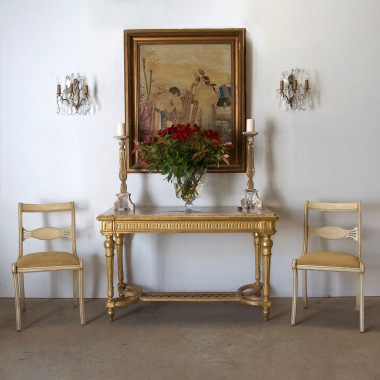
I have treasured my memory of this last afternoon in Palermo and am continually charmed by the casual luxury evident in interiors such as this. The flash of gilt and the grace of line that are an enduring code of beauty, not necessarily formal but an uplifting backdrop to any life and an exquisite addition to any home. The featured large, framed, late 19th century, Orientalist needlework appears to be channeling the wall decoration of the Palermo palazzo and the late 19th century, French gilt and marble centre table is imbued with a similar heritage glamour - the gilt gently gleams, the neoclassical design and motifs are undeniably elegant, and it would serve as a very appropriate table to throw your car keys onto when you walk in the door at the end of the day.
To read the Newsletter in its entirety please follow this link https://mailchi.mp/9ff03ea72658/gilt-complex